Tuesday, 9 May 2017

Evaluation

Evaluation

You may work together on preparing your evaluation, but the final evaluation should be all your own individual work. The questions that must be addressed in the evaluation are:
• In what ways does your media product use, develop or challenge forms and conventions of real media products?
• How does your media product represent particular social groups?
• What kind of media institution might distribute your media product and why?
• Who would be the audience for your media product?
• How did you attract/address your audience?
• What have you learnt about technologies from the process of constructing this product?
• Looking back at your preliminary task, what do you feel you have learnt in the progression from it to the full product?

Question 1 and 2

https://www.slideshare.net/MegCampbell7/question-1-nd-2-of-evaluatio

Question 3

https://www.slideshare.net/MegCampbell7/question-3-media-evaluation-75793558


Question 4 and 5

https://www.slideshare.net/MegCampbell7/question-4-and-5-evalation

Question 6


https://www.slideshare.net/MegCampbell7/question-6-evaluation-75793596

Question 7

https://www.slideshare.net/MegCampbell7/question-7-evaluation-75793626

Tuesday, 2 May 2017

The main task finished piece

The main task finished piece

storyboard for main task

Storyboard  for Main Task


Here is the link to the story board (It starts with page two, then it goes to page one)
scan.pdf‎ (430 KB‎)

Focus group results

Focus Group Results

We asked 14 people that match our target audience to answer three questions regarding our task. Here are the results (the answers in bold are the most popular):

1) Where should the location of the film take place?
  • School: 29%
  • Scary Forrest/Wood: 71%
  • House: 0%
2) What should the main character be looking for in the chosen location?
  • Demonic Spirit: 86%
  • Werewolf: 0%
  • Vampire: 14%
3) What should the film be called?
  • Death Around the Corner: 29%
  • Draven Woods: 14%
  • Child of Beautiful Shadows: 57%

Target Audience

Target Audience

We have made a decision that our film task will be aimed at teenagers/young adults who like the horror genre. The reason why we think that these age groups would be the best to aim our task that is because from looking at most of the horror films already released, it is most likely that they will not be aimed at children, or even elderly people. Therefore, aiming our horror themed task at the teenage/young adult generation would be sensible as they are the age groups that usually enjoy films with frightening themes.


Also there is some evidence that men enjoy the horror genre more than women. This is probably because of the elements of gore and other frightening themes that wouldn't necessarily appeal to a female audience.Image result for target audience for horror films

Tuesday, 13 December 2016

Bathes 5 narrative codes
Bathes 5 narrative codes

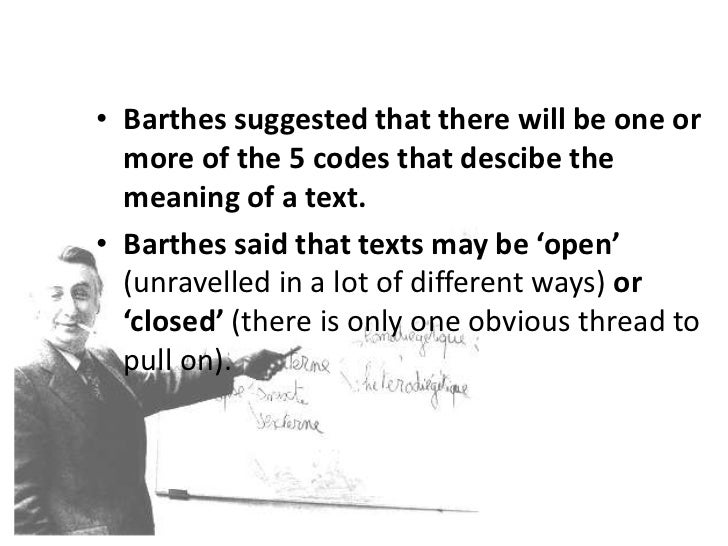
• Barthes suggested that there will be one or  more of the 5 codes that descibe the  meaning of a text.• Barthes said that...
The 5 codes   • Hermeneutic /     Enigma code   • Proairetic/Action     code   • Semantic code   • Symbolic code   • Refer...Hermeneutic/Enigma code• This code refers to mystery within a text.  Clues are dropped, but no clear answers  are given.• ...
Proairetic/Action code• This code contains sequential elements of  action in the text.• Proairetic elements add suspense t...
Semantic code• This code refers to parts within the text  that suggests or referes to additional  meanings.• Elements of t...
Symbolic code• This code is about symbolism within the text.• It exercises opposites to show contrast and  create greater ...
Referential code• This code refers to anything in the text  which refers to an external body of  knowlegde such as scienti...

The Hermeneutic Code (HER)

The Hermeneutic Code refers to any element of the story that is not fully explained and hence becomes a mystery to the reader.
The full truth is often avoided, for example in:
  • Snares: deliberately avoiding the truth.
  • Equivocations: partial or incomplete answers.
  • Jammings: openly acknowledge that there is no answer to a problem.
The purpose of the author in this is typically to keep the audience guessing, arresting the enigma, until the final scenes when all is revealed and all loose ends are tied off and closure is achieved.

The Proairetic Code (ACT)

The Proairetic Code also builds tension, referring to any other action or event that indicates something else is going to happen, and which hence gets the reader guessing as to what will happen next.
The Hermeneutic and Proairetic Codes work as a pair to develop the story's tensions and keep the reader interested. Barthes described them as:
"...dependent on ... two sequential codes: the revelation of truth and the coordination of the actions represented: there is the same constraint in the gradual order of melody and in the equally gradual order of the narrative sequence."

The Semantic Code (SEM)

This code refers to connotation within the story that gives additional meaning over the basic denotative meaning of the word.
It is by the use of extended meaning that can be applied to words that authors can paint rich pictures with relatively limited text and the way they do this is a common indication of their writing skills.

The Symbolic Code (SYM)

This is very similar to the Semantic Code, but acts at a wider level, organizing semantic meanings into broader and deeper sets of meaning.
This is typically done in the use of antithesis, where new meaning arises out of opposing and conflict ideas.

The Cultural Code (REF)

This code refers to anything that is founded on some kind of canonical works that cannot be challenged and is assumed to be a foundation for truth.
Typically this involves either science or religion, although other canons such as magical truths may be used in fantasy stories. The Gnomic Code is a cultural code that particularly refers to sayings, proverbs, clich�s and other common meaning-giving word sets
 

Friday, 25 November 2016

Horror codes and conventions and the movies that go with them

Horror codes and conventions and the movies that go with them

After analysing a number of horror films, I have noted that there are a number of codes and conventions that are usually adhered to in horror films. They are used because they are proven to have a strong effect on audiences, and add to their enjoyment of the film.
Like the opening of most films, horror films will usually begin with institutional information relating to the film; the companies most involved in the making and distribution of the film. These will be presented in a way that suits the film; the logos may be made darker and more gothic. This is usually necessary, especially if the institutions involved are not specifically involved in the horror genre.
The main codes and conventions that feature throughout horror films are;
  • The soundtrack is usually very slow and eerie, usually made this way through the use of classical instruments or a synthesiser. Many horror films will have the music playing at a very low volume to start with, and this  then increases in volume up to the point where the action happens. There is also the use of sudden, sharp music at points in the film where suspense is being built up. This puts the audience on edge, and when the action appears it make them more jumpy.
  • Throughout the horror film, long shots are used often. These create a strong sense of place, and builds up the creepy, isolated atmosphere that most horror films wish to create. Close-ups are not used as often, as they usually convey emotions of characters, with the principal emotion in horror being terror, these are not usually necessary. The close-ups in horror films will usually be on objects rather then on people, to show their significance.
  • The setting is usually very dark. This is used because it creates a strong feeling of terror; the audience can sympathise with how little the characters can see and feel the tension this causes.
  • The weather in horror films is usually stormy when the main action of the film takes place. This is called pathetic fallacy because it reflects the feelings of the characters.
  • The most vulnerable characters in horror films are usually females. This is because they are stereotyped as the weaker sex, and make for the easiest victims. Males are usually portrayed as the stronger and more rational character, who has to protect the female.
  • The killer usually has a trademark that makes them unique; this could be the way in which they kill someone, or the way they leave a crime scene. It can even be the type of person that they prey on. They are also shown to be alsmot inhuman. They show very little feeling when they kill/hurt their victims, and if someone attempts to hurt them, they appear unaffected. A good example of this is in the film ‘Halloween’. Michael Myers is at one point stabbed, but carries on like he has not been hurt.
  • Screaming is used throughout horror films and has become one of the major conventions of the genre. Weapons are also conventions of horror films; the most common being a knife. Like blood, this has become such a major convention, that it could possibly be described as an icon of the horror genre.
  • Jump cuts are the most common way of changing shots in horror films. This is because it creates a feeling of tension, and when a number of shots are edited this way in a short space of time, it creates a sense of confusion for the audience, positioning them to be scared when it is necessary in the film.
https://louisabroadheadmediablog.wordpress.com/2011/12/13/codes-and-conventions-of-horror-films/

Films of interest;

  • Friday the 13th
This follows the tropes of the genre of horror as it features young people camping in the woods. The sound track is slow and foreboding and suggests the events that will happen. It is unusual however as you see things from the killers perspective.

  • Dawn of the dead
 

The fact there are flashes to different segments of the story makes for an interesting and unusual piece as well as one that goes against the codes and conventions of conventional horror. However it follows the clear structure of the sub genre of zombie movies and id therefore still follows the conventions of horror.
  • Jaws