Tuesday, 13 December 2016

Bathes 5 narrative codes
Bathes 5 narrative codes

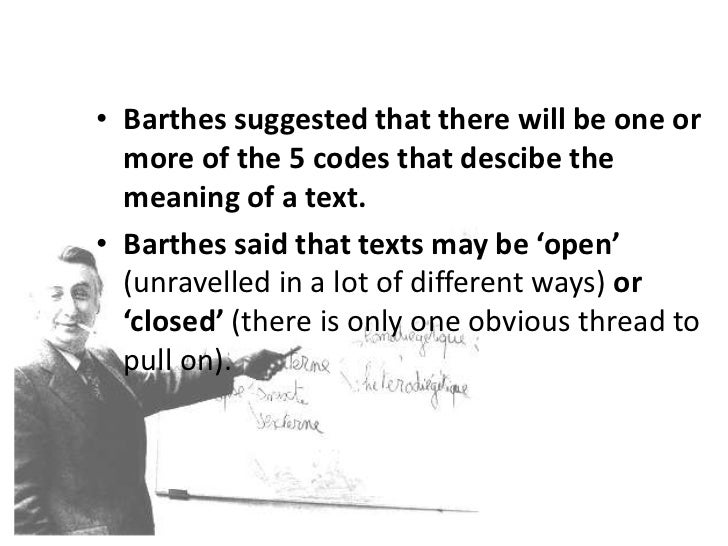
• Barthes suggested that there will be one or  more of the 5 codes that descibe the  meaning of a text.• Barthes said that...
The 5 codes   • Hermeneutic /     Enigma code   • Proairetic/Action     code   • Semantic code   • Symbolic code   • Refer...Hermeneutic/Enigma code• This code refers to mystery within a text.  Clues are dropped, but no clear answers  are given.• ...
Proairetic/Action code• This code contains sequential elements of  action in the text.• Proairetic elements add suspense t...
Semantic code• This code refers to parts within the text  that suggests or referes to additional  meanings.• Elements of t...
Symbolic code• This code is about symbolism within the text.• It exercises opposites to show contrast and  create greater ...
Referential code• This code refers to anything in the text  which refers to an external body of  knowlegde such as scienti...

The Hermeneutic Code (HER)

The Hermeneutic Code refers to any element of the story that is not fully explained and hence becomes a mystery to the reader.
The full truth is often avoided, for example in:
  • Snares: deliberately avoiding the truth.
  • Equivocations: partial or incomplete answers.
  • Jammings: openly acknowledge that there is no answer to a problem.
The purpose of the author in this is typically to keep the audience guessing, arresting the enigma, until the final scenes when all is revealed and all loose ends are tied off and closure is achieved.

The Proairetic Code (ACT)

The Proairetic Code also builds tension, referring to any other action or event that indicates something else is going to happen, and which hence gets the reader guessing as to what will happen next.
The Hermeneutic and Proairetic Codes work as a pair to develop the story's tensions and keep the reader interested. Barthes described them as:
"...dependent on ... two sequential codes: the revelation of truth and the coordination of the actions represented: there is the same constraint in the gradual order of melody and in the equally gradual order of the narrative sequence."

The Semantic Code (SEM)

This code refers to connotation within the story that gives additional meaning over the basic denotative meaning of the word.
It is by the use of extended meaning that can be applied to words that authors can paint rich pictures with relatively limited text and the way they do this is a common indication of their writing skills.

The Symbolic Code (SYM)

This is very similar to the Semantic Code, but acts at a wider level, organizing semantic meanings into broader and deeper sets of meaning.
This is typically done in the use of antithesis, where new meaning arises out of opposing and conflict ideas.

The Cultural Code (REF)

This code refers to anything that is founded on some kind of canonical works that cannot be challenged and is assumed to be a foundation for truth.
Typically this involves either science or religion, although other canons such as magical truths may be used in fantasy stories. The Gnomic Code is a cultural code that particularly refers to sayings, proverbs, clich�s and other common meaning-giving word sets
 

Friday, 25 November 2016

Horror codes and conventions and the movies that go with them

Horror codes and conventions and the movies that go with them

After analysing a number of horror films, I have noted that there are a number of codes and conventions that are usually adhered to in horror films. They are used because they are proven to have a strong effect on audiences, and add to their enjoyment of the film.
Like the opening of most films, horror films will usually begin with institutional information relating to the film; the companies most involved in the making and distribution of the film. These will be presented in a way that suits the film; the logos may be made darker and more gothic. This is usually necessary, especially if the institutions involved are not specifically involved in the horror genre.
The main codes and conventions that feature throughout horror films are;
  • The soundtrack is usually very slow and eerie, usually made this way through the use of classical instruments or a synthesiser. Many horror films will have the music playing at a very low volume to start with, and this  then increases in volume up to the point where the action happens. There is also the use of sudden, sharp music at points in the film where suspense is being built up. This puts the audience on edge, and when the action appears it make them more jumpy.
  • Throughout the horror film, long shots are used often. These create a strong sense of place, and builds up the creepy, isolated atmosphere that most horror films wish to create. Close-ups are not used as often, as they usually convey emotions of characters, with the principal emotion in horror being terror, these are not usually necessary. The close-ups in horror films will usually be on objects rather then on people, to show their significance.
  • The setting is usually very dark. This is used because it creates a strong feeling of terror; the audience can sympathise with how little the characters can see and feel the tension this causes.
  • The weather in horror films is usually stormy when the main action of the film takes place. This is called pathetic fallacy because it reflects the feelings of the characters.
  • The most vulnerable characters in horror films are usually females. This is because they are stereotyped as the weaker sex, and make for the easiest victims. Males are usually portrayed as the stronger and more rational character, who has to protect the female.
  • The killer usually has a trademark that makes them unique; this could be the way in which they kill someone, or the way they leave a crime scene. It can even be the type of person that they prey on. They are also shown to be alsmot inhuman. They show very little feeling when they kill/hurt their victims, and if someone attempts to hurt them, they appear unaffected. A good example of this is in the film ‘Halloween’. Michael Myers is at one point stabbed, but carries on like he has not been hurt.
  • Screaming is used throughout horror films and has become one of the major conventions of the genre. Weapons are also conventions of horror films; the most common being a knife. Like blood, this has become such a major convention, that it could possibly be described as an icon of the horror genre.
  • Jump cuts are the most common way of changing shots in horror films. This is because it creates a feeling of tension, and when a number of shots are edited this way in a short space of time, it creates a sense of confusion for the audience, positioning them to be scared when it is necessary in the film.
https://louisabroadheadmediablog.wordpress.com/2011/12/13/codes-and-conventions-of-horror-films/

Films of interest;

  • Friday the 13th
This follows the tropes of the genre of horror as it features young people camping in the woods. The sound track is slow and foreboding and suggests the events that will happen. It is unusual however as you see things from the killers perspective.

  • Dawn of the dead
 

The fact there are flashes to different segments of the story makes for an interesting and unusual piece as well as one that goes against the codes and conventions of conventional horror. However it follows the clear structure of the sub genre of zombie movies and id therefore still follows the conventions of horror.
  • Jaws


Tuesday, 15 November 2016

Further Horror codes and conventions

Further Horror codes and conventions


This is a good example of satirizing the codes and conventions of horror movies with is jokey style that follows most of the conventions of a horror movie and stereotypes the types of people who are usually victims in horror movies.  

Codes and conventions of Horror movies

Codes and conventions of horror movies

This is a website that provides a large number of codes and conventions that are commonly found in horror movies including falling over nothing, commonly investigating a strange noise and running towards their death rather than from away from the danger.  
 
This image also helped with our research as it shows some of the statistics of the horror movies we are looking at my satirizing some of the most common parts of the genre.
Get the best royalty-free graphics, images, icons, buttons, textures, backgrounds, and more! Start your 7 day free trial today to get access to hundreds of thousands images!:


Tuesday, 8 November 2016

Teachers comments

Teachers comments

Preliminary task

Preliminary task


 Evaluation

This piece fulfills the brief by clearly showing match on action, shot reverse shot and the 180' rule. This was shown through entering the room, the conversation that follows which is simply on a straight line and the shots backing perfectly into the next through editing.

Initially we had no actors to perform in the piece and we had never used the editing the software before which proved a challenge. To over come this we watched tutorials on how to use the software and asked people who we knew to get the actors we needed for the piece.

We could of improved it by improving the focus on the cameras and making sure there were no gaps in the editing process, but all of this will be corrected with time and with more use of the cameras.

The following links are to the tutorials we used;
This helped by showing us the basics of the how to use final cut pro which allowed us to use the software .
 
 
We learned valuable lessons from this including how to use the cameras appropriately and the importance of a good script making the piece more then what it could be. We also learned the value of team work and how this worked within the roles allocated to ourselves in the group.  
  

Friday, 30 September 2016

Photos showing camera angles and lighting

Photos showing camera angles and lighting


This is our piece showing camera angles and lighting we explored using previous tutorials from the blog

Tuesday, 27 September 2016

How to upload images from a lumix mx7 camera

Step 1

Connect the small end of the USB cord to the corresponding port on your camera.

Step 2

Connect the other end of the USB cable to an open USB port on your computer.

Step 3

Press the power button on your camera to turn it on. If prompted, select "USB" or "Computer" mode on your camera.

Step 4

Click the "Start" button in the lower left corner of your computer screen.

Step 5

Select the "Computer" option in the right hand column of the "Start" menu.

Step 6

Double click the icon for your camera. It may be labeled as "Panasonic camera," or it may be labeled as "Removable disk". The exact wording will depend on your computer system and your camera.

Step 7

Locate the picture files that you wish to download from the camera, then select them by holding down the "Ctrl" button as you click on each file.

Step 8

Right click on a selected file and choose the "Copy" option.

Step 9

Navigate to the location on your computer where you would like to save the pictures.

Step 10

Right click inside the folder, then select the "Paste" option.

For more go to
http://techin.oureverydaylife.com/download-files-panasonic-camera-computer-11728.html

Friday, 16 September 2016

Key Terms

Key Terms

Media codes and conventions:

Codes and conventions. Codes are systems of signs, which create meaning. Codes can be divided into two categories – technical and symbolic. Technical codes are all the ways in which equipment is used to tell the story in a media text, for example the camera work in a film

Conventions
Conventions are the widely recognised way of doing something which is to do with content, form and style. There are two types of conventions which consists of:

- Technical Conventions - A convention in a technical area. These conventions, apply to the majority of music videos for e.g. the video being the same length as the song and fast cuts

- Genre Conventions - this is where conventions are associated with a particular genre. An example of this would be Pop videos, that ba e dance routines and bands performing songs with instruments.

Codes
Codes are systems of signs, which create meaning. These may include both technical codes or symbolic codes. An example of a code that creates meaning is gold chains and baggy pants in a Hip-Hop music video.

-  Technical Codes - This is all the ways in which equipment is used to tell the story in a media text (e.g. - camera work or editing).

-  Symbolic Codes - This shows what is beneath the surface of what we see. For example, a characters action can show you how they are feeling and their emotions.

Technical codes:

Technical codes are all the ways in which equipment is used to tell the story in a media text, for example the camera work in a film

Symbolic codes:

Symbolic codes show what is beneath the surface of what we see. For example, a character's actions show you how the character is feeling.

http://media-studies.tki.org.nz/Teaching-media-studies/Media-concepts/Codes-and-conventions

Denotation and Connotation:

In media-studies terminology, denotation is the first level of analysis: What the audience can visually see on a page. Denotation often refers to something literal, and avoids being a metaphor. Here it is usually coupled with connotation, which is the second level of analysis, being what the denotation represents.

Examples

In order to understand fully the difference between denotation and connotation in media studies and semiotics, it is helpful to examine some examples:
Example one.
The denotation of this example is a red rose with a green stem. The connotation is that is a symbol of passion and love—this is what the rose represents.
Example two.
The denotation is a brown cross. The connotation is a symbol of religion, according to the media connotation. To be more specific, this is a symbol of Christianity.
Example three.
The denotation is a representation of a cartoon heart. The connotation is a symbol of love and affection, not in the way of a rose, but a symbol of true love.

Mise-En-Scene:

When applied to the cinema, mise-en-scène refers to everything that appears before the camera and its arrangement—sets, props, actors, costumes, and lighting.
http://www.slideshare.net/guest1db652/mise-en-scene-3850550


The breif

Video

Preliminary exercise: Continuity task involving filming and editing a character opening a door, crossing a room and sitting down in a chair opposite another character, with whom she/he then exchanges a couple of lines of dialogue. This task should demonstrate match on action, shot/reverse shot and the 180-degree rule.

Main task: the titles and opening of a new fiction film, to last a maximum of two minutes.

All video and audio material must be original, produced by the candidate(s), with the exception of music or audio effects from a copyright-free source. Both preliminary and main tasks may be done individually or as a group. Maximum four members to a group.

Tuesday, 13 September 2016

Camera Research and how to use


Camera Research

  Hopefully some of this will help with how cameras work because they helped me.

Camera Iris (Fstop)

The word “aperture” means “opening.” In the world of cinematography, this opening is located in the camera, more specifically on the lens. The size of the aperture is regulated by the lens’ diaphragm, which opens to admit light and closes to block it. The figure to the right shows the diaphragm, which is formed by several blades that leave a circular hole in the center – the aperture.


  https://en.wikipedia.org/wiki/Diaphragm_(optics)

Shutter speed

Shutter speed is ‘the amount of time that the shutter is open’.
In film photography it was the length of time that the film was exposed to the scene you’re photographing and similarly in digital photography shutter speed is the length of time that your image sensor ‘sees’ the scene you’re attempting to capture.
http://digital-photography-school.com/shutter-speed/

ISO Film Speed

ISO film speeds are an important part of film photography as each film speed is used for different scenarios and lighting conditions. The first and most important piece to understand about film speed is that the higher the ISO number, the more grain is visible on the film and the subsequent prints. However, sometimes you simply cannot avoid using the faster film speed and will just have to accept the level of graininess that comes with it.
For more go to:
 

Depth of field

Depth of field refers to the range of distance that appears acceptably sharp. It varies depending on camera type, aperture and focusing distance, although print size and viewing distance can also influence our perception of depth of field. This tutorial is designed to give a better intuitive and technical understanding for photography, and provides a depth of field calculator to show how it varies with your camera settings.

Panasonic Lumix LX7

 
Found this leaflet showing how to use a Panasonic lumix 7 camera. I hope its useful.
Notable pages:
Change battery & check for memory card; page 18
Put camera into manual mode and put camera into video mode; page 48
Change IOS, F-Stop, shutter speed: pages 61, 109 (and above hyperlink)
Zoom/focus: pages 92-95
Use light meter: (above hyperlink)
Playback record image: page 152


Blogger turorials

BLOGGER TUTORIAL

This should help set up a blog like it helped me :)
https://support.google.com/blogger/answer/154172?hl=en
http://blogger-template-editing.blogspot.co.uk/2009/05/adding-drop-down-labels-menu.html